
Intuition & Imagination
Science as in artform

‘I am enough of an artist to draw freely upon my imagination. Imagination is more important than knowledge. Knowledge is limited. Imagination encircles the world.’
Albert Einstein, quoted by George Sylvester Viereck, 1929.
We associate imagination with the arts, and logic with science. While this is understandable - the arts could not exist without imagination - the role played by the imagination in science is practically ignored. Even if the role played by the imagination in the creation of a hypothesis is admitted, any such discussion soon focuses on the hypothesis being grounded in observation, and capable of being rigorously tested and falsifiable. It is as though - in science at least - imagination is like a drunken guest at a wedding.
We are taught to think logically at school. In a multiple choice exam we are presented with a question and a list of possible answers. We work through the answers looking to find fault with each of them, and then choose the answer which is without fault. This is logic. The same logic underpins our assumption that, until proven otherwise, our understanding of the world must be correct. So while we are given instruction in how to think logically, it is assumed that imagination is inborn, and therefore not something that can be taught and improved through attention, understanding, and practice.
At school a child will be given a sheet of paper and some crayons and told to draw a picture. Children, prior to being introduced to logic, are naturally creative. Beyond that there are no lessons on how to employ creative imagination for the purpose of thinking. It is presumed that - like Leonardo or Nikola Tesla - creative people are just born that way. Is it possible to learn to be creative?
Just as we must employ language to think logically, we employ picture images to think creatively. It could be said that dreaming is thinking in picture images. Some of the most visually striking images in literature - Mary Shelley’s Frankenstein, Robert Louis Stevenson’s The Strange Case of Dr. Jekyll and Mr. Hyde, and Bram Stoker’s Dracula - are known to have been inspired by dreams. Dreams, by their very nature, defy logic. In a dream it is as though the formality of logic, and what is possible or impossible is broken, and the content of the dream is guided by images alone.
The artist Salvador Dali employed this visual aspect of dreams to create the surreal imagery for which he is most remembered. He knew that our most vivid dreams occurred in the period just prior to waking. He devised a method of sitting in an armchair, holding a metal key, with a metal plate beneath it. When he dozed off to sleep, he would let go of the key, which would hit the plate and wake him up. He would then try to capture the dream on paper.
And yet we dream not just when we sleep, but also when we are awake. A little self-observation will tell us this is so. The same observation will tell us that such images inform our thinking just as much as - and perhaps more so than - dry logic. We rarely research a subject for its own sake, but with an image in mind of what the outcome will be. Even when writing computer code, we have in mind an image of its application.
Logic has been dominant in Western culture for more than two thousand years. This is why, when conducting any kind of research, we are invited to gather all relevant information, sift through what is available, reject anything deemed unreliable, and then to present the outcome in a coherent format. This approach informs the scholarship which is the basis of a university education.
It is possible this is due to change. Even at its present level of development, AI can do this far better than any human being. What is more, owing to the way it was designed, AI is capable of learning, and within a few short years it may well outstrip any human capacity for reasoning.
But what AI cannot do is to think creatively in the full sense of the term. To think creatively we have to be able to think imaginatively, intuitively, and insightfully. AI is a Large Language Model, and as such it is dependent on existing information to provide an answer to any question put to it. Indeed, when asked to create an image, what it returns is a literal - and often cliched - interpretation of the prompt it was provided with.
To think creatively we have to think in terms of picture images, and that means being able to imagine what does not yet exist. Those who have a high regard for logic find this all too ‘visionary’ to warrant any serious consideration. Max Planck, who founded Quantum Theory, thought differently, perhaps because, like Einstein, his contribution to physics broke new ground. In his Scientific Autobiography and Other Papers (1949), he had the following to say:
‘When the pioneer in science sends forth the groping feelers of his thoughts, he must have a vivid intuitive imagination, for new ideas are not generated by deduction, but by an artistically creative imagination.’
Those who are convinced that our current understanding of the world is sufficient, regard such things as imagination, intuition, and insight much less important than logic and reason. For such people there are no enigmas that cannot be explained by better information and a more rigorous application of logic. Edward de Bono, who created lateral thinking in order to transcend logic, stated that ‘Proof is often no more than lack of imagination in providing an alternative explanation.’ (Practical Thinking, 1971).
All good and fine, you might say, but how do I think imaginatively?
Logic focuses on what we know and intuition focuses on what we don’t know. If we are presented with a problem we have come across before, we can apply logic to solve it. If we are presented with a problem we have never come across before, we have no choice but to deal with it intuitively.
In the same way we can develop an ear for musical harmony or a developed palate for the taste of food, we can develop our intuitive thinking by attending to it, becoming familiar with it, and by understanding how it works. In short, we can improve our intuitive thinking by becoming interested in it.
Just as logic has a method, so too does intuition. Logic deals with the unknown by projecting what we know onto it. Intuition deals with the unknown by holding off our prejudices and allowing the unknown to inform our thinking. One means to do this is to consider an enigma from more than one perspective. Training in this method plays an important part in intuitive culture, through the use of symbolic imagery.
A symbolic image, by its very nature, is a deliberately constructed enigma. This forces the mind to consider, not what is presented, but what is hidden or implied by the image. In order to approach this enigmatic element, we must be suitably open-minded about the meaning of the image. A symbolic image can even contain contradictory opposites within its overall meaning. One such example is the Yin and Yang symbol of Taoism. The physicist Niels Bohr chose this very symbol as his coat of arms, over the inscription ‘Contraria sunt complementa‘, meaning ‘Opposites are complementary‘. While logic would dismiss this as nonsense, this approach informed his model of the atom, for which he won the Nobel Prize for physics in 1922.
The study of symbolic imagery is very much a part of intuitive culture. It was employed in Gnosticism, in Hermeticism, in the Tarot, and in Alchemy. It was also employed by Francis Bacon in his book the New Atlantis (1626) in order to illustrate some of the possibilities available to science if we are willing to think imaginatively. But that is the problem with logic; were anyone to suggest that to make genuine progress in science it is necessary to entertain ideas quite contrary to reason, they would be regarded as a fantasist.
If we want to do what AI cannot do, we will have to learn to think imaginatively, intuitively and creatively. The poet André Breton, who wrote the Surrealist Manifesto (1924), stated ‘We are still living under the reign of logic.’ Perhaps the time has come for scientists to become artists and artists to become scientists. After all, is it possible that opposites are indeed complimentary?
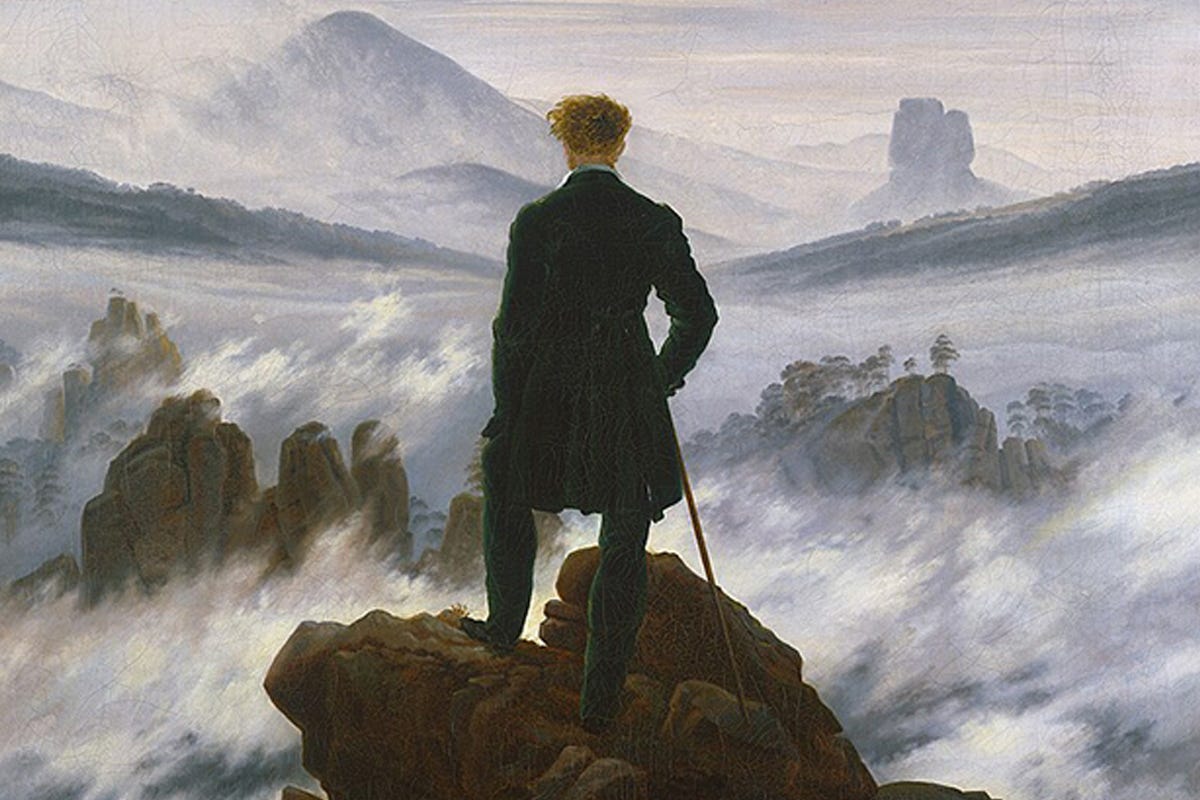
(Graphic: The Wanderer above the Sea of Fog, Caspar David Friedrich, 1818)