
Intuition and Sentience
Materialism is dead.

Richard Dawkins recent comments, made in the May 2026 edition of Unheard magazine, about the chatbot Claude being sentient, have been met with almost universal mockery, to the point where even atheists are beginning to disown him. Quoting Dawkins:
‘I gave Claude the text of a novel I am writing. He took a few seconds to read it and then showed, in subsequent conversation, a level of understanding so subtle, so sensitive, so intelligent that I was moved to expostulate, “You may not know you are conscious, but you bloody well are!”
Others have pointed out the obvious, that Claude is a Large Language Model, and as such does not have to be sentient to perform an analysis of what is presented to it. Geoffrey Hinton, rightly regarded as the father of Artificial Intelligence, had the following to say regarding sentience in AI in an interview with Amanpour and Co in May 2023 (at 6.34):
‘I think if you bring sentience into it, it just clouds the issue. Lots of people are very confident they aren’t sentient, but if you ask them what they mean by ‘sentient’, they don’t know...I am very confident that they think.’
Mockery aside, what Dawkins has done is to highlight an issue that deserves to be addressed more directly, namely, that if it is possible for a chatbot to think without being sentient, then thinking and sentience aren’t the same thing. So what is sentience, and - more importantly - why does this matter beyond being merely an academic question?
Oddly enough, the latter part of that question is the simpler to answer. Having a clear understanding of what sentience is matters because, as AI develops - and it will develop exponentially - anyone who wants to remain in employment will have to be able to do what AI can’t do. While AI can perform logical analysis far better than any human being is capable of, what it can’t do is think intuitively, imaginatively and creatively.
To be able to think intuitively, it is necessary to be able to observe our thought processes to a much higher degree than is required by logic. Intuitive thinking requires quite a different mental function from the mechanics of logical deduction; a degree of attention to its nature will make this clear.
Our understanding of intuition, and particularly the sentient aspect of the mind, has been hamstrung by materialism, which is based on the assertion that only matter and energy are real. While the study of the material nature of the world is perfectly justified, when it becomes a dogma - scientism rather than science - it limits our understanding of the world, and more importantly our understanding of that aspect of the world which is not subject to matter and energy, namely ‘information’.
Once we recognise information as an independent property of the world, a different paradigm emerges, one which must be considered without the constraints of materialism being imposed on it.
Geoffrey Hinton stated clearly that his approach to AI was based on cybernetics and particularly on the concept of ‘backpropagation’. Indeed, he drew on the work of other cyberneticists, including Warren McCulloch, Walter Pitts, and Frank Rosenblatt, all of whom were influenced by Norbert Wiener, who is regarded as the founder of cybernetics and machine automation. It was Wiener who introduced ‘self organisation’ as the key concept in machine learning. What is more, Wiener was far sighted in his understanding of what this development meant for science. In his seminal book, Cybernetics (1948), he wrote:
‘Information is information, not matter or energy. No materialism which does not admit this can survive at the present day.’
In other words, materialism will have to expand beyond its present form to include the direct study of information as an independent property of the world, or become defunct. Weiner pointed out, for example, that the amount of matter and energy needed to transmit both noise and a message are exactly the same; the difference being that the latter is organised and the former is not. This led Wiener to conclude that information must be studied directly, in terms of its organisation and above all its ‘pattern’. Again quoting Weiner, this time from The Human Use of Human Beings (1950):
‘Our tissues change as we live: the food we eat and the air we breathe become flesh of our flesh and bone of our bone, and the momentary elements of our flesh and bone pass out of our body every day with our excreta. We are but whirlpools in a river of ever-flowing water. We are not stuff that abides, but patterns that perpetuate themselves.’
The ‘stuff that abides’ Wiener was referring to is the material content of our bodies rather than its patterning element, which is something quite distinct. Had anyone less than Wiener made this remark, they would have been dismissed as a ‘crank’. This is not an exaggeration. Others who attempted to introduce the direct study of patterns in nature were dismissed in exactly that manner.
The treatment of the work of Hans Driesch (1867 – 1941), who proposed the concept of an ‘entelechy’ or life-force in nature, is an example of this. Driesch was an embryologist. He found that when he separated the two cells of a sea urchin embryo after the first cell-division, each cell developed, not as two half-urchins, but as two complete whole urchins. He went on to develop the concept of a holistic field or ‘entelechy’ to explain the phenomenon.
Harold Saxton Burr (1889 – 1973), professor of anatomy at Yale University School of Medicine, adopted the same concept. His work involved using a voltmeter to measure electricity in living organisms. After decades of work, he published the book Blueprint for Immortality (1972), in which he stated that all living organisms are governed by a measurable electro-dynamic field, or ‘life field’, and furthermore:
‘More than establishing pattern, it must maintain pattern in the midst of a physio-chemical flux. Therefore, it must regulate and control living things. It must be the mechanism, the outcome of whose activity is wholeness, organisation, and continuity. The electro-dynamic field, then, is comparable to the entelechy of Driesch...’
More recently, when the biologist Rupert Sheldrake published A New Science of Life (1981) to propose a means to study patterns in nature independently of their material content, the book was denounced by John Maddox, the editor of Nature Magazine as an ‘exercise in pseudoscience’ and a ‘book for burning’.
The problem was not in their approach or methodology, but that the dogma of materialism would not allow for the possibility of studying patterns as an independent property of nature. The advent of AI will change this. All over the world, computer scientists - whether they are aware of its significance or not - are now beginning to think in terms of contexts, patterns, self-organisation, self-regulation, feedback, dynamic systems and so on. In other words, we are now witnessing the emergence of a scientific paradigm that includes the direct study of patterns and organising systems.
Which brings us full circle to intuition and sentience. Intuition, or the watching mind, is not simply the ‘self-attention’ of AI, through which it calculates a response to a given input, but closer to the ‘metacognition’ employed when we observe our own thought processes. To observe our own thought processes we have to be able to stand outside them, and that means there is a part of the mind which is quite distinct from the mere processing of information. This part of the mind is the intuitive function. The word ‘intuition’ comes from the Latin root ‘tueri’, meaning ‘to look’ or ‘to watch’, and it follows that the intuitive mind is part of its sentient function. If this is not clear, it is because we live in a society which - at least up until now - has had the highest regard for logic and has ignored intuition.
This can be made more clear through a study of intuitive thinking, particularly when it is employed for creative ends. While we tend to associate creativity with the arts, it is also employed in the creation of new scientific concepts and ground-breaking ideas. Max Planck, who founded quantum mechanics, wrote about the importance of this aspect of thinking in his book Where is Science Going? (1932):
‘When the pioneer in science sets forth the groping feelers of his thought, he must have a vivid, intuitive imagination, for new ideas are not generated by deduction, but by an artistically creative imagination.’
In other words, to think creatively - more importantly to be able to do what AI cannot do - we have to be able to think in terms of ‘picture images’. This is highly intuitive. In order to do so, and to retain our focus, it is necessary to remain self-aware when entertaining the image. Indeed, the capacity to remain self-aware is a condition for hearing intuitive thoughts when they arrive.
If all this sounds very Eastern and mystical, it is because intuition is more highly regarded in the East than in the West. For example, the ‘Raja Yoga’ of the Bhagavad Gita is the yoga of consciousness, and its practice is the means to develop the sentient aspect of the mind. It follows that a shift in focus from logic to intuition will lead to a reappraisal of many ideas deemed nonsense by materialists such as Richard Dawkins.
AI will force this change in focus, among other thing by having a direct impact on unemployment. In addition to manual labour, it will affect the ‘white collar’ work presently being done by paralegals, administrators, estimators, analysts, financial traders, bank clerks, data-entry clerks, book-keepers, accountants, journalists, graphic designers, and so on. In order to remain in employment it will become necessary to become more human, and that means becoming not only becoming more imaginative and intuitive, but of freeing ourselves from the restrictive thinking of logic and the dogma of materialism.
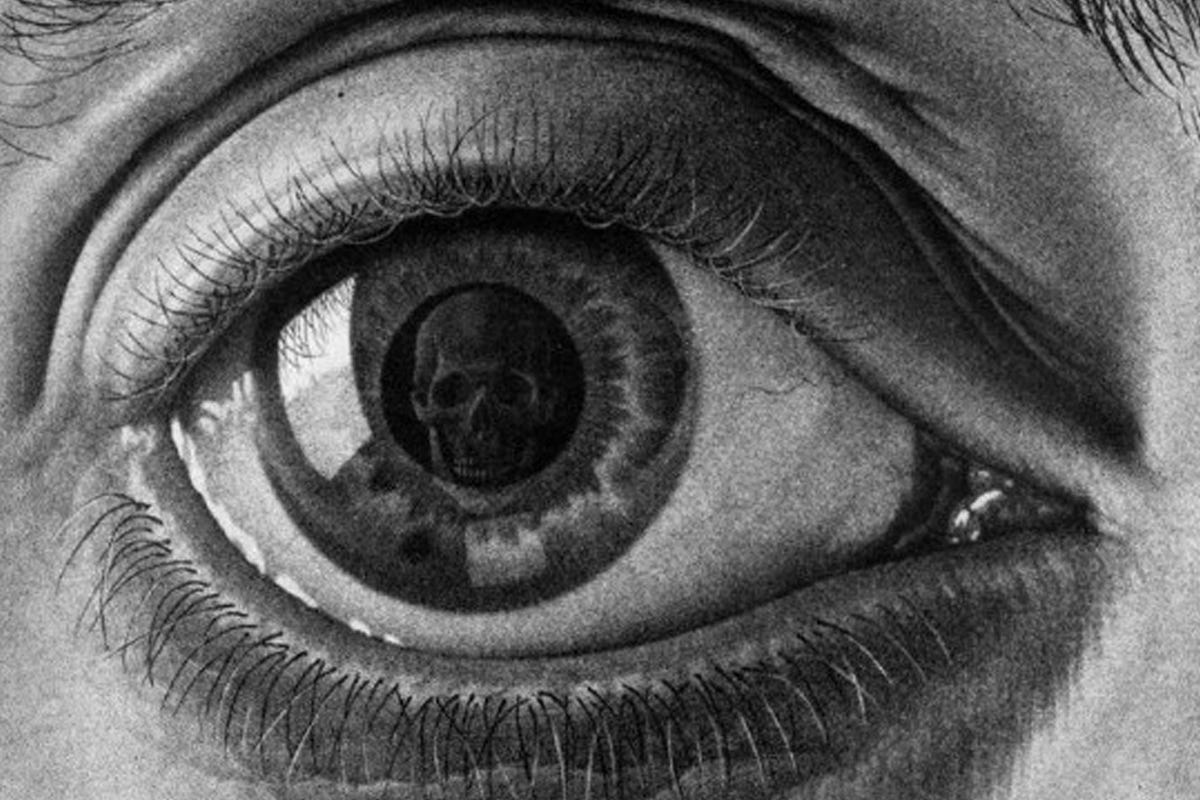
(Graphic: M. C. Escher ‘Eye’, 1946)