
Intuition and Symbolism
Symbolism is to intuitive thinking what language is to logic.

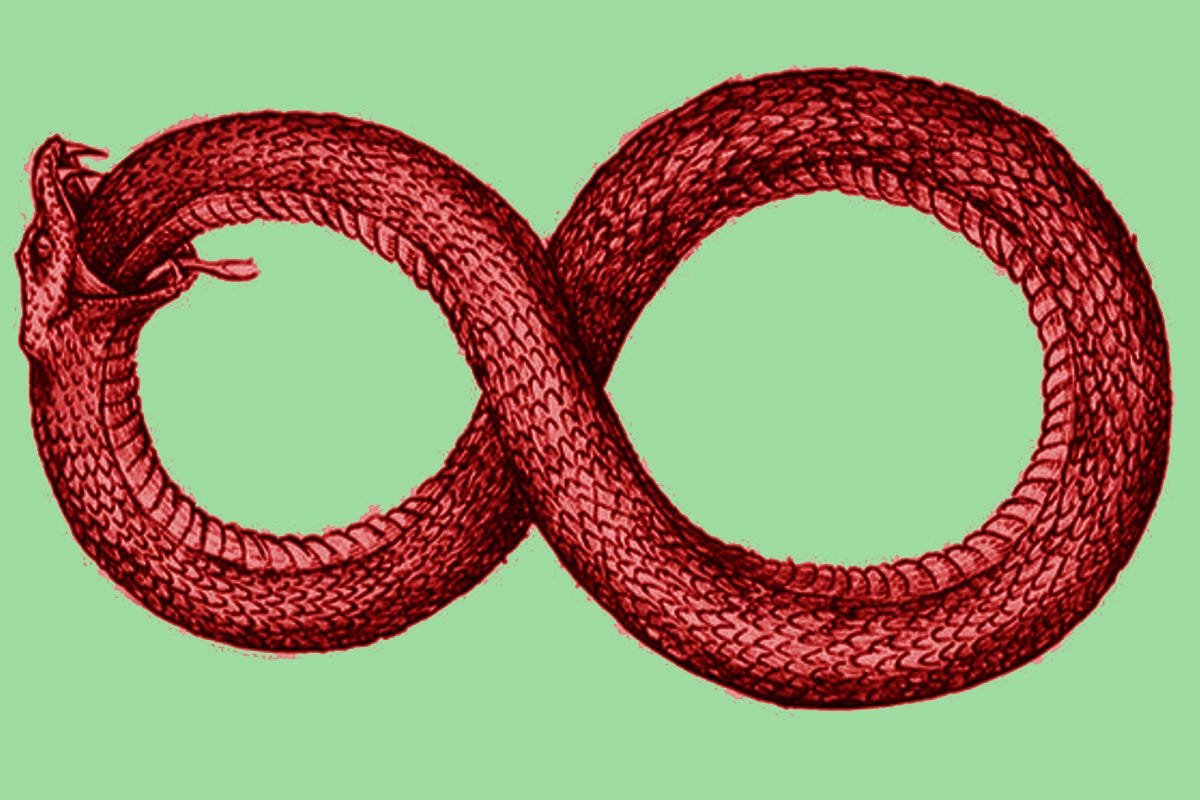
Logic demands fixed definitions and formal arguments, which is why a logical statement must be coherent, clearly put, and most of all free of error. Symbolic imagery on the other hand is often surreal and obscure, as though it conveys its message by indirect means. For those who are used to the formality of logic, the indirectness of symbolic imagery can be unnecessarily obscure and indirect.
Intuitive thinking teaches us not to take the world at face value. When we are presented with an enigma, if we think logically, we will find an explanation within our present understanding. If we think intuitively, we will seek to discover what is behind the enigma - in other words, we will look for what we presently don’t see.
A symbolic image presents us with a deliberate enigma, created to provoke us to look beyond the apparent absurdity of what is presented. In this way a symbolic image provokes the intuitive mind. Seen from this perspective, a symbolic image is the means to train the mind to think intuitively.
As a form of language, symbolic imagery has existed longer than logic. The Sphinx of Giza is an example of a complex idea expressed through symbolic imagery. Orthodox history, written in the language of logic, dismisses the Sphinx as a mythical creature created by a superstitious culture. And yet both its content and the demands of its construction indicate it could not have been created on a whim.
Another example of a complex teaching presented in symbolic imagery is the Tarot. One of the earliest Tarot decks, the Tarot de Marseilles, was clearly cut by an inartistic hand, and yet its content is too developed to be the product of ignorance. The Wheel of Fortune, The Hanged Man, Temperance (Time), The Moon, and the World, for example, all have a philosophical content.
Oswald Wirth (1860 - 1943), the Swiss artist who created his own, more refined version of the Tarot, had this to say about symbolic imagery as the means to transmit ideas intuitively:
‘A symbol can always be studied from an infinite number of points of view; and each thinker has the right to discover in the symbol a new meaning corresponding to the logic of his own conceptions.
‘As a matter of fact symbols are precisely intended to awaken ideas sleeping in our consciousness. They arouse a thought by means of suggestion and thus cause the truth which lies hidden in the depths of our spirit to reveal itself.’ (Symbolisme Hermétique, pp. 58-40, 83)
Because intuition is largely ignored by mainstream culture, the richness of this approach is lost on many, who dismiss it as mere superstition. The means to approach a symbolic image is the same as with any enigma - whether it is a person, an event, or a natural object - which is to say, intuitively. To think intuitively is to silence the logical mind, at least for a moment, and allow the intuitive mind to speak. The myth of Echo and Narcissus is a symbolic representation of the relationship between the ordinary mind and the intuitive mind.
There are many enigmas in life; people, events, the wider world, and even our own inner life. We do not see ourselves as we should, and the phenomenon of hindsight, when we look back on an action undertaken in the past and now see what was not apparent at the time, is clear evidence of this. If we ask why we don’t see ourselves rightly, it is because we see what is obvious well enough, but not what is unobvious or hidden. Symbolic imagery represents what is hidden in the psyche.
Alchemy, another form of thinking expressed through symbolic imagery, may seem unnecessarily obscure, until its main premise is understood rightly, which is to turn base metal into gold. The base metal in question is not an actual metal, but human nature. We are capable of being much more than we are, provided we regard ourselves that way.
For all the rationality of the Modern Era, we are more governed by symbols than we will admit. What is success, a hero, a victory, a king or a leader, other than a symbolic image? If God as a father figure is a symbolic image, then so too is the Blind Watchmaker of atheism.
The ability to think intuitively exists within each of us, and like any other ability it can be greatly enhanced by direct attention and practice. The study of symbolic imagery, provided it is done with understanding, is a means to do this.
(Graphic: The Ouroboros of Hermeticism)