
Intuition & the Heresies
To be a heretic is to think as an individual

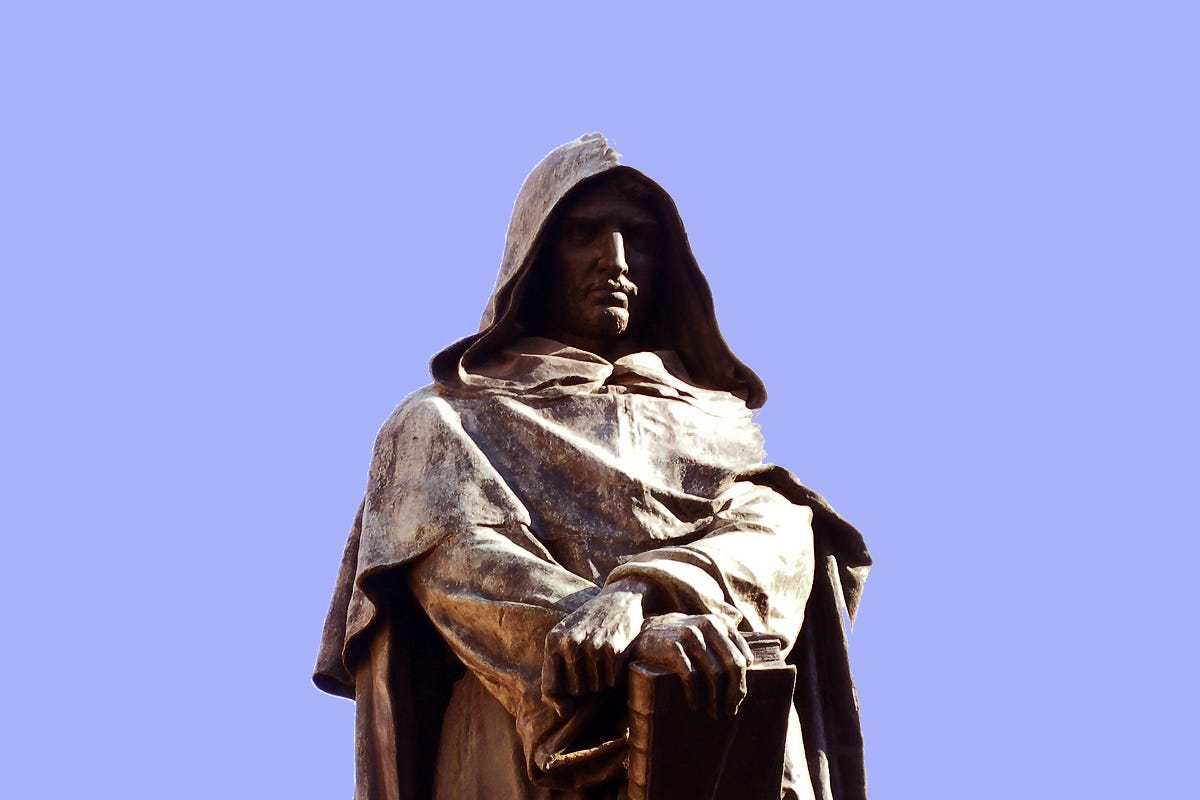
What we know about the heresies comes mostly from the records of the Church, and particularly from the Inquisition, which was set up to discredit and eradicate them. It is for this reason that most people know little about the heresies beyond that they existed.
The records of the Church tend to focus on the Jansenist, the Arian, the Pelagian, and Donatist heresies. This is because they were largely the product of charismatic leaders, who for the most part had doctrinal disputes with the Church about matters of theology.
Much more dangerous to the authority of the Church were the Manichean, the Gnostic, and the Cathar heresies. This is because they were not based on theological disputes, but on something more fundamental to human nature - namely that the knowledge they possessed was not based on the say-so of any authority, but on individual thinking and direct experience.
If all this seems far removed from the secularism of the Modern Era, it is not. The Modern Era has adopted the same authority-based approach to truth as was the case when it was governed by religion. Just as there were religious heresies, so too are there now scientific heresies. It is for this reason that a study of the heresies can be instructive.
Christianity, the main religion of Europe, was never meant to serve Rome. The phrase ‘Render unto Caesar that which is Caesar’s,’ and ‘My kingdom is not of this world,’ can be found in the Gospels. Rome had been Pagan up until the time of the Emperor Constantine, who is said to have had a vision of the Cross on the night before an important battle, accompanied by the admonition ‘Under this sign conquer.’ From that moment on Christianity and the authority of Rome became synonymous, and to challenge one was to challenge the other. The treatment of the heretics as enemies of the Church of Rome became inevitable.
Although Manichaeism, Gnosticism, and Catharism each had their own distinct cultures, they also had much in common. Of the three, Manichaeism was the first and, being so, it is possible that its teaching influenced the latter two.
Manichaeism was notably dualist, which is to say it regarded evil not as the absence of good, but as an active principle in the world. Dualism was problematic for the Church because it regarded itself as the sole representative of ‘good’, and ‘evil’ as any person or group who wouldn’t submit to its influence. It is also notable that all three heresies taught reincarnation, which had been ‘anathematised’ or cursed in the Council of Constantinople in 553 AD:
‘If anyone assert the fabulous pre-existence of souls, and shall assert the monstrous restoration which follows from it: let him be an anathema.’
Reincarnation was an issue for the Church because the prospect of any of the disciples reincarnating as ordinary people - particularly as women - would have undermined its authority. It is owing to its treatment that reincarnation is associated with the East, and with Hinduism and Buddhism in particulay. Charles William King (1818 – 1888), who made a study of the heresies in his The Gnostics and their Remains (1864), wrote:
‘In the history of the Church it is most certain that almost every notion that was subsequently denounced as heretical can be traced up to Indian speculative philosophy as its genuine fountain-head...’
Evidence for this can be found in the Shabuhragan, one of the few surviving Manichean tracts. Its founder, the prophet Mani (216 - 274 AD) was regarded as a Buddha in his own lifetime. The Shabuhragan tells us that the King of Turan addressed Mani in the following way: ‘Of all these you are the greatest and lightest, for, in truth, you are the Buddha yourself.’
A second and equally important heresy was Gnosticism. With regard to Gnosticism we are fortunate that the Pistis Sophia (c. 3 - 4AD), the most complete and reliable of the Gnostic texts, survived the Inquisition because it was rediscovered in the 18th Century. George Mead (1863 - 1933), its translator, took the view that the similarities between Gnosticism and Manichaeism indicated a common source. Of the Gnostics, Mead tells us that reincarnation ‘formed an integral part of their system’.
Which brings us to the third and equally important heresy, Catharism. The Cathars, like the Manicheans and the Gnostics, were also accused by the Church of being dualists and of believing in reincarnation. The 14th century Inquisitor, Bernard Gui, in dismissive tones, tells us:
‘Also, under no circumstances will they kill any animal or winged creature, for they say and believe that there are in brute animals and even in birds those spirits which leave the bodies of men...and that these spirits pass from one body to another.’
In addition, Gui informs us that, whereas the Roman Church was wholly patriarchal, the Cathars were inclusive:
‘This they apply even to women, with the same proviso that they belong to their sect. Thus they teach that every holy person is a priest.’
Perhaps the greatest problem for the Church was that none of the three main heresies were willing to submit to its authority. Whereas the Church demanded blind faith and obedience, the teachings of the Manichean, Gnostic and Cathar heresies were based on direct and personal experience. The word ‘gnostic’ means ‘knowledge’, and it refers to direct and personal insight into the nature of the world. The records of the writer Alain de Lille (c. 1128), who commented extensively on the heresies, are highly revealing in this regard:
‘The perfect freedom with which they were endowed meant repudiation of all formal religious institutions and law. No hierarchy was needed. One of the group was known as a ‘prophet’ and apparently was their chief spokesman, although any of the company might experience visions which would be recounted in private meetings.’
The antagonism towards the heresies came from the dogma of the Church. Dogma is founded on logic, which means there can be only one truth or ‘correct opinion’ on any matter. Once Christianity had become the official religion of Rome, there could be only one correct opinion, dictated by the Church of Rome. It was owing to this that the Church became increasingly authoritarian. This culminated in the thirteenth century when the Cathar stronghold of Bezier in France was attacked. The Catholic historian Paul Johnson, in his A History of Christianity (1976), tell us:
‘In 1209, Arnold Aimery exulted to the Pope that the capture of Beziers had been ‘miraculous’; and that the crusaders had killed 15,000, ‘showing mercy neither to order, nor age nor sex’. Prisoners were mutilated, blinded, dragged at the hooves of horses and used for target practice.’
The brutality speaks for itself. The net effect was that from the thirteenth century onwards, all opposition to the Church was crushed; nothing could be said in public about its brutality or corruption and most certainly nothing could be said to challenge its dogma. It was this extreme form of censorship that created the conditions for the Reformation and the Renaissance that followed, when Martin Luther, Galileo, and Giordano Bruno all suffered the same fate as the heretics before them.
We might think, with the advent of the Modern Era, this dark history is now behind us, and yet, while Western society is no longer governed by any religious authority, the assumption that we must defer to authority regarding matters of truth remains intact. Whereas the Church had its dogma, science too has adopted the same assertion that there is only one ‘correct opinion’ through which all phenomena must be interpreted.
The paradigm of the present era is materialism. From the point of view of materialism, matter and energy are regarded as the basis of all observable phenomena. Owing to the adoption of materialism as a dogma, to suggest that matter and energy do not explain the whole of nature is regarded as unscientific. Indeed, any scientist who dares to question the assertion that materialism is sufficient to explain the whole of nature - Rupert Sheldrake, Harold Saxton Burr, and Hans Driesch are examples - is dismissed as a crank or as possibly motivated by questionable interests. This was the case when Rupert Sheldrake published A New Science of Life (1981) to propose that patterns in nature could be studied independently of their material content. His book was denounced by John Maddox, the editor of Nature Magazine as an ‘exercise in pseudoscience’ and a ‘book for burning’.
So while we are no longer governed by a religious authority, the assumption that we must defer all thinking and judgement to a scientific authority remains intact. This is because Western culture is still dominated by logic, which demands uniformity of thought. If A equals A, there can be no exception where A equals B. Intuitive thinking is however personal, direct, and conditional. An intuitive insight can render, in an instant, all that we once assumed was a complete and whole view of the world to be no more than the product of limited perception.
The heretics were intuitive. To question authority, to challenge the governing paradigm, and above all to be open to insight - in the Modern Era as in the Middle Ages - would render us heretics in every sense of the word.
(Graphic: Monument to Giordano Bruno, Ettore Ferrari, 1889)