
Intuition & the Psychological Method
P. D. Ouspensky: intuitive genius

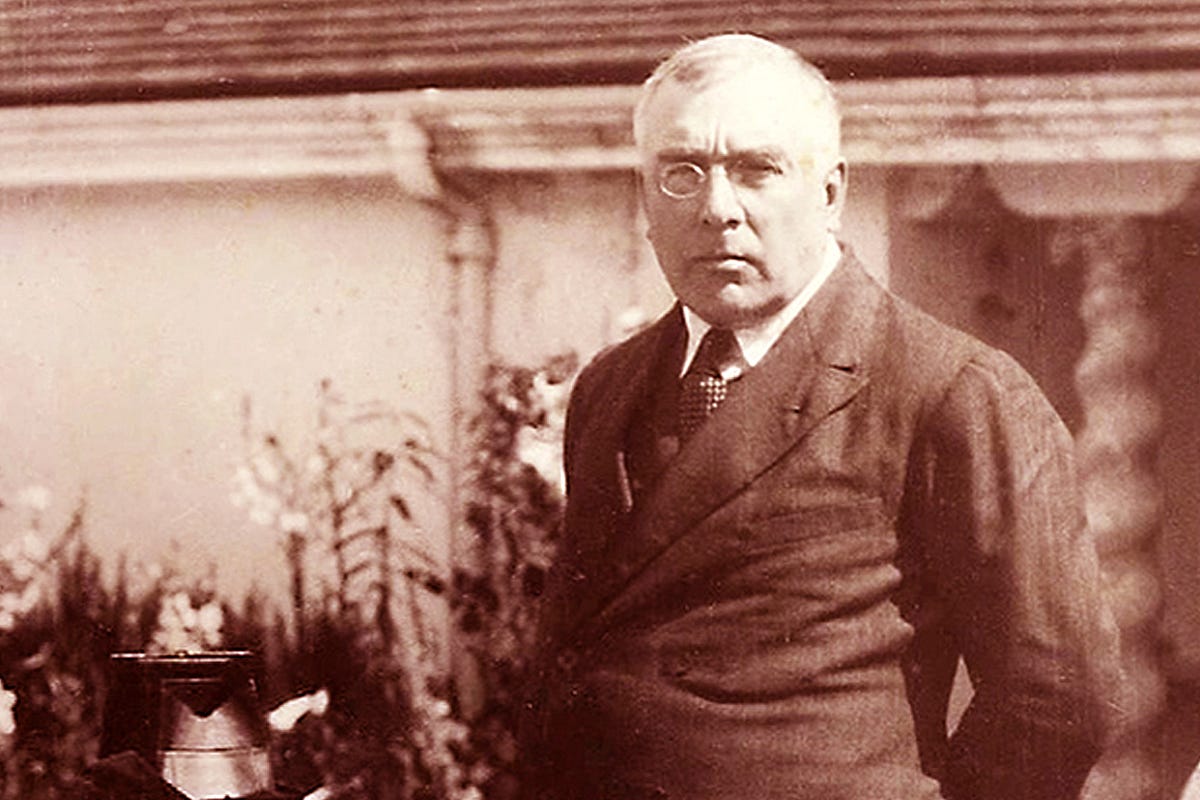
‘It is the year 1906 or 1907. The editorial office of the Moscow daily paper The Morning. I have just received the foreign papers, and I have to write an article on the forthcoming Hague Conference. French, German, English, Italian papers. Phrases, phrases, sympathetic, critical, ironical, blatant, pompous, lying and, worst of all, utterly automatic, phrases which have been used a thousand times and will be used again on entirely different, perhaps contradictory, occasions. I have to make a survey of all these words and opinions, pretending to take them seriously, and then, just as seriously, to write something on my own account. But what can I say? It is all so tedious.’
Peter Demianovich Ouspensky was born in Moscow on 5th March, 1878. His mother was an artist, and his father, an officer in the Russian Survey Service, had a keen interest in mathematics. Ouspensky seems to have been mischievous as a youth, and it is recorded that he was expelled from school for painting graffiti on a wall. He went on to study at Moscow University, where he attended as a ‘free listener’, which meant he could attend but had no right to pass exams. After finishing his education he became a journalist, and then worked his way up to the editorial offices of The Morning.
Beyond a good intellect and an ability to write, there is nothing to mark Ouspensky out in his early years. By the time he was 28 however, he had developed an interest in Theosophy and in higher mathematics. These twin interests led him to publish his first book, The Fourth Dimension, in 1909. The book dealt with the nature of time, and drew on the works of the British mathematician Charles Hinton (1853 – 1907), as well as his own interest in Theosophy.
He followed this three years later with Tertium Organum (1912). The title, meaning ‘the third canon of thought’, was a reference to the two earlier canons of thought, Aristotle’s Organon and Francis Bacon’s Novum Organon, and indicated the seriousness of the undertaking. Tertium Organum provides a detailed - almost laborious - analysis of the nature of time and space, as well as our relationship to them. As with The Fourth Dimension, Ouspensky drew on his twin interests in higher mathematics and esotericism to make the point that the world we know and see is but a small part of a greater whole, which is largely hidden from us. He termed this approach ‘higher logic’:
‘Higher logic existed before deductive and inductive logic was ever formulated. Higher logic may be called intuitive logic, the logic of infinity, the logic of ecstasy.’
His interest in esotericism, or hidden knowledge, led him to travel widely, to England, France, Italy, Egypt, Turkey, Sri Lanka and India, in pursuit of it. He intended to travel further, to Burma, Japan and America, but found his plans were interrupted by the First World War. Then on returning to Russia in 1915, he came across a small group of people gathered around the enigmatic teacher George Gurdjieff (1866 – 1949).
Gurdjieff himself had travelled much in search of the same hidden knowledge. He had then returned to Moscow with what Ouspensky described as an esoteric system ‘which had been entrusted to him by others’. This teaching, later known as ‘The System’, was largely unknown to the West at the time. Ouspensky records that he probably got it from a Sufi school in Kashgar in Chinese Turkestan, but its exact source is unknown.
Ouspensky worked with Gurdjieff from 1915 until 1918, at which point he parted company with him. He wrote that he had begun to feel he had ceased to understand Gurdjieff, or that Gurdjieff’s views had changed. So it was that Ouspensky arrived in London, in 1921, and began to establish himself as a teacher in his own right.
While many regard Ouspensky as no more than a disciple of Gurdjieff, much of what is in Tertium Organum in 1912, and in A New Model of the Universe, which he described as ‘begun and practically completed before 1914’, had been written before meeting Gurdjieff in 1915. It follows that it is from these two books that we can discern what was uniquely Ouspensky’s.
He subtitled A New Model of the Universe, ‘Principles of the psychological method in its application to problems of science, religion, and art.’ What Ouspensky referred to as the ‘Psychological Method’ therefore did not come from Gurdjieff. He initially referred to it in Tertium Organum:
‘In order to obtain at least some kind of an answer to the questions which torment us we must turn in quite another direction - to the psychological method of study of man and humanity.’
A fuller definition of the psychological method had to wait until A New Model of the Universe:
‘The most ordinary mind, let us call it the logical mind, is sufficient for all the simple problems of life.
‘But a logical mind which knows its limitedness and is strong enough to withstand the temptation to venture into problems beyond its powers and capacities becomes a ‘psychological mind’. The method used by this mind, that is, the psychological method, is first of all a method of distinguishing between different levels of thinking and of realising the fact that perceptions change according to the powers and properties of the perceiving apparatus.’
The psychological method Ouspensky referred to involves the type of change of perception resulting from intuitive insight. The aim of the psychological method is therefore to lead us from the limitations of purely logical thinking into intuitive thinking. An example of this can be found in Chapter Five, The Symbolism of the Tarot, where Ouspensky depicts each of the cards of the Higher Arcana symbolically in order to evoke, rather than to explain the meaning.
Ouspensky conducted study groups in London and New York, which were attended by, amongst others, T. S. Eliot, Aldous Huxley and Kenneth Walker. A record of answers to questions put to him were compiled in the book The Fourth Way (1947). Owing to his association with Gurdjieff - a full account can be found in the book In Search of the Miraculous (1949) - much of what Ouspensky taught is regarded as merely an interpretation of Gurdjieff’s teaching, and yet from the record of answers, it is clear that Ouspensky was speaking first hand.
It is recorded that, in his later years, Ouspensky abandoned the System. When asked by Kenneth Walker whether he had done so, he answered ‘There is no System’.
This was confusing for those present, who may not have understood that Ouspensky was employing the psychological method. The logical method expresses everything in terms of opposites - yes or no - but the psychological method is intended to provoke insight. An example of this may be found in the question put to Bodhidharma (c. 5th - 6th Century), the founder of Zen, by his successor Huike. ‘I seek the Dharma,’ he asked. To which Bodhidharma answered, ‘I have nothing to teach you. I have nothing to say.’ Zen is highly intuitive, which is why it appears illogical to those who do not understand its method.
The whole of Ouspensky’s teaching was about inner transformation through very strict practices intended to facilitate a change of perception from the limitations of the ordinary mind. Such a change cannot be manufactured, not least because it depends on factors we presently cannot see. Once, when asked if the object of his teaching was to produce ‘superman’, he answered ‘This is not a superman farm!’
It is likely Ouspensky knew more than he wrote or said. He played the role of the intellectual, and yet he thought little of the intellect as the means to arrive at intuitive insight. The ‘miraculous’ Ouspensky sought was not any crude breaking of the laws of nature or any hallucinatory magic, but of the arrival of new knowledge by means of insight. This is not unlike the Satori, or ‘sudden enlightenment’, of Zen Buddhism. In Buddhist teachings it is made clear this cannot be manufactured, and that the whole of Buddhist teaching is merely a preparation for it. In the terminology of the Fourth Way, this is referred to as ‘higher emotional centre’. As Ouspensky put it:
‘When you find yourself in a state approaching higher emotional centre, you will be astounded how much you can understand at once - and then you come back to your normal state and you forget it all.’
Ouspensky’s genius was not fully recognised in his lifetime. Those who came closest often did so by inference rather than directly. The artist and writer Rom Landau (1899 – 1974), who attended Ouspensky’s study groups in Kensington, London, recorded his impressions in his book God is my Adventure (1935). Landau writes that Ouspensky entered the room and sat before the assembled group:
‘One of the speaker’s first sentences was: ‘None of you here is awake. What you all do is sleep.’ After he had made this remark he stopped abruptly, as though withdrawing from the world of words into his own more comfortable world. His appearance suddenly suggested to me some modern version of Buddha.’
References
P. D. Ouspensky, A New Model of the Universe, (London: Routledge, 1967), introduction
P. D. Ouspensky, Tertium Organum, (London: Kegan Paul, 1947) ch 21, p. 232
Tertium Organum, p. 273
P. D. Ouspensky, A New Model of the Universe, (London: Routledge, 1967), preface to 2nd edition
Colin Wilson, The Strange Life of P. D. Ouspensky, Chapter Six ‘There is no System’
P. D. Ouspensky, The Fourth Way (New York, Random House, 1971) Chapter XIV, p. 387
Rom Landau, God is my Adventure (London: Faber and Faber, 1941), p. 167