
Intuition & Truth
Why logic is no longer sufficient to understand the world

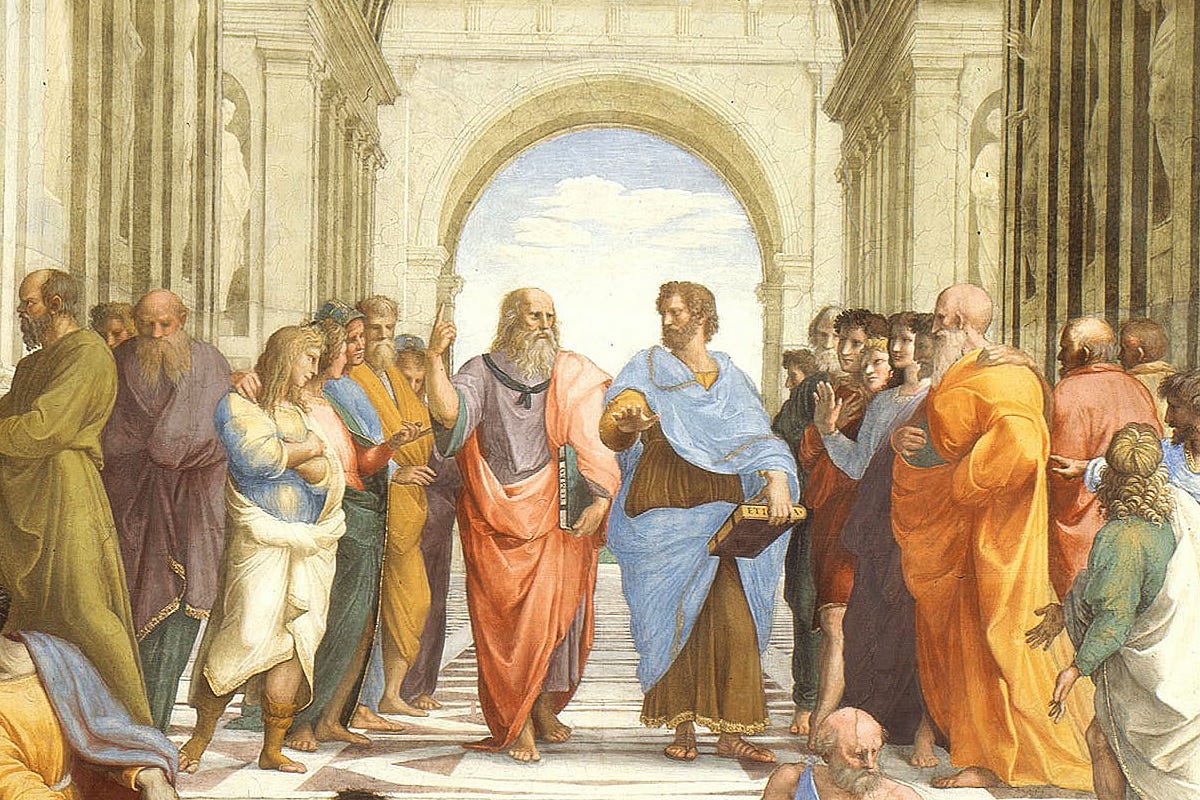
Our concept of truth comes from Plato, who taught that truth is absolute and unchanging. He used the analogy of the cave-dwellers, who are chained to face a wall. Behind them there is a fire. In front of the fire and to the back of the cave-dwellers, figures move. All the cave-dwellers can see are shadows cast by the figures. In this analogy, truth is represented by the fire, and the changing world of the senses is represented by the shadows.
While our concept of truth comes from Plato, the means to arrive at it comes from Aristotle, who studied under him for twenty years. Aristotle gave us logic, which states that if A equals A, then A does not equal B. In addition he gave us the method known as the syllogism, which is an argument in three parts; a major premise, a minor premise, and a conclusion. A classic example of a syllogism is ‘Socrates was a man; men are mortal; therefore Socrates was mortal’.
The Platonic view of truth was then adopted by the Church through Augustine - truth became synonymous with God - and then Aristotelian logic was adopted by the Church through Thomas Aquinas. In spite of the secularism of the Modern Era, we have never quite escaped the Absolute truth of Plato or the logical method of Aristotle.
To think logically, we have to define, label and categorise what we know. Once we have done this we can then put together the information we have into an argument. This makes for precision in thinking and can help to eliminate confusing and contradictory ideas. The problem is, we can’t define, label and categorise what we don’t know, and if we limit our thinking to logic, we simply project what we know onto what we don’t know. This results, not in new ideas and insights, but in a dogmatic and narrow-minded view of the world.
To think about what we don’t know, we have to employ intuition. It follows that there are two methods of approaching truth: logic and intuition.
About logic we know a great deal. We are taught to think logically at school, primarily through the multiple-choice examination system, where we are presented with a question and a list of possible answers. We work through the answers finding fault with each of them until we find an answer which is without fault and we choose that as the correct one. If we get enough answers right, we pass the exam and go on to university.
But no one teaches us to think intuitively. It is assumed that intuition is a kind of ‘gut instinct’ that we can do little about. Because we pay little attention to it, when we are faced with a crisis in life or a problem for which there is no obvious right or wrong answer, we experience a kind of gut-wrenching feeling.
And yet intuition is a great deal more than that. Gut-feeling is only one aspect of intuition. The other two aspects of intuitive thinking are emotional understanding and insight.
Emotional understanding plays an important part in Stoicism, for example. If we are faced with an unpleasant event, we may become angry, resentful, or bitter about it, or we can seek to reconcile our emotions by changing our view of the event. It was the Stoic emperor Marcus Aurelius who wrote ‘Remove the thought ‘I am hurt’, and the hurt itself is removed.’ This is quite contrary to logic, which asserts that there is only one correct way of looking at any situation.
Even more important is the little understood phenomenon known as ‘insight’. A solution arrived at by way of insight is quite different from one arrived at by means of logic. While logic seeks to make sense of what we already know, insight draws our attention to what we do not know. Through insight we may see, suddenly and in an instant, something that prior to the experience we couldn’t even imagine. This is sometimes referred to as a ‘eureka moment’, after Archimedes, who, after seeing the solution to a complex mathematical problem instantly and whole, reputedly ran naked from his bath shouting ‘Eureka!’ or ‘I have found it!’. The ‘seeing’ that insight refers to is of course ‘seeing with the mind’.
Insight is only possible because we don’t see the world in its entirety. This means that what limits our understanding of the world is not logic or methodology, but limited perception.
We have given too little attention to perception. Perception is ‘how we see the world’. The dominance of logic and absolute truth means that, if another person sees the world differently from us, we have to criticise them in order to show up the errors in their thinking. This is the basis of the whole Western approach to truth. To admit that, where two views exist, both views arise from a limited view of the world would lead to what is called ‘dangerous relativism’.
It is interesting to note that this was the accusation levelled against Thomas Kuhn on publication of The Structure of Scientific Revolutions (1962). Kuhn had pointed to the part played by perception in scientific research, and in particular to the limiting effect of a ‘paradigm’ or an agreed way of looking at the world. His response to the criticism that he was introducing relativism into science was unapologetic:
‘One consequence of the position just outlined has particularly bothered a number of my critics. They find my viewpoint relativistic, particularly as it is developed in the last section of this book. My remarks about translation highlight the reasons for the charge. The proponents of different theories are like the members of different language-culture communities. Recognizing the parallelism suggests that in some sense both groups may be right.’
Our capacity for insight is, at least in part, dependent on our ability to adopt a disinterested attitude towards our own thinking. This is very much like the disinterested attitude found in Stoicism. It is not indifference, but rather the recognition that perception can be limited by prejudice, and that we can see more and know more than we presently see by considering a situation from more than perspective. This is the approach advocated by William James, who described himself as a ‘pluralist’, by which he meant that the best way to approach a subject was to study it from more than one point of view:
‘There is no such thing as an ‘absolute’ point of view from which the world can be seen as it ‘really’ is. All our points of view are partial and limited, and our ‘truths’ are always relative to those points of view.’
Absolute truth and its corresponding logic is not suited to the Modern Era. Both arose at a time when society, including its customs and attitudes, changed very little and very slowly. The hallmark of the Modern Era is constant change. The red telephone boxes that were once everywhere in the UK were made of cast iron, because it was assumed they would always be in use. The Encyclopedia Britannica, in print for more than 240 years, printed its last edition in 2012, only ten years after the Wikipedia was founded. Five years ago it would have been absurd to suggest that computers can think; now the concern is that within five years AI may be able to think better than even its creator.
We are now living in a time of constant and ongoing change, where the fixed definitions of logic are becoming not only defunct, but a barrier to understanding the world we live in. Constant change means that more and more of our judgments will become relative to the context in which they are made, and therefore intuitive. Either we master intuitive thinking or we will find ourselves increasingly out of touch with the Modern Era.
(Graphic: detail from Raphael’s The School of Athens, c. 1509)