
Intuition and Zen
Eastern and Western approaches to knowledge.

It is an oversimplification to say that the West is logical and the East is intuitive. The West has its own intuitive culture - the arts and mysticism for example - and in the East, in 6th Century BC India, there was the Nyāya school of Hinduism which developed a form of logic independently of Aristotelianism. That said, there is a degree of truth in saying that intuitive culture is more clearly expressed in the East.
Zen, for example, is highly intuitive. Many people find Zen perplexing - ‘show me the sound of one hand clapping’ - and dismiss it as a sort of strange gibberish. But of course there is more to it than that, and a degree of understanding will indicate this clearly.
Zen was founded by Bodhidharma in about the 5th Century AD. He was succeeded by his disciple Huike, and when Huike died, his teaching split into two schools - Zen and Shin (or Shinto). Zen is based on the principle of Jiriki, or ‘self power’, and Shin is based on the principle of Tariki, or ‘other power’. In Zen there are no gods to pray to, nor is there room for sentimental religiosity.
Zen focuses on perception, or the way we see ourselves and the world around us. One method of teaching associated with Zen - the Koan - is based on this. The aim of the Koan is to broaden our perception, not through logical reasoning or argument, but through sudden insight or ‘satori’. Koans are like puzzles or enigmatic statements designed to provoke the listener to think about what is being expressed in an indirect manner. It could be said that Zen was an early form of Lateral Thinking. Some Koans are humorous:
‘Two brothers lived in a Zen monastery. The elder brother was wise, and the younger brother was stupid and had only one eye. One day a wandering monk knocked on the gate of the monastery and asked if he could stay for a while. The elder brother said that he could stay, but only if he was able to show he had a genuine understanding of Zen. So he instructed the wandering monk to have a debate with his younger brother about the essence of Zen.
‘But I’m stupid,’ said the one-eyed, younger brother; ‘he’ll easily get the better of me.’
So the elder brother advised them to have the debate in silence. The wandering monk and the younger brother went off to the meditation hall to have the debate in silence. Finally, after a short while, the wandering monk came out and walked up to the elder brother.
‘I’m not worthy of your company,’ he said. ‘You led me to believe your brother was stupid, but I am the one who is stupid.’
The elder brother asked the wandering monk to explain.
‘I began by holding up one finger, representing Bodhidharma, without whom there would be no Zen. Then your brother held up two fingers, representing Bodhidharma and his teaching, without which there would be no Zen. I then held up three fingers representing Bodhidharma, his teaching, and his followers, without which there would be no Zen. Then he shook his fist in my face, meaning ‘unless all three are one there would be no Zen.’ The wandering monk then bowed deeply and left.
At that moment the one-eyed brother emerged from the mediation hall.
‘Where’s that %@#! wandering monk?’ he demanded. The elder brother asked him to calm down and explain what happened.
‘Well,’ said the one-eyed brother, ‘I did my best not to let you down, but he started it. He held up one finger, meaning ‘you’ve only got one eye.’ I tried to stay calm and held up two fingers complimenting him on his two eyes. Then he held up three fingers meaning ‘between us we’ve only got three eyes,’ I went to punch him and he ran off.’
The originator of the story clearly understood perception very well. We think we see the world as it is, and fail to see that what we see is determined by our own perception, and our perception can change with insight. The aim of Zen - at least one of its aims - is to get us to realise that limited perception is a fact of life, and its solution is not through reasoning or argument, but through insight. Many of the Zen practices are designed to bring this about. One such practice is known as the ‘isness’ exercise.
Isness makes little sense to anyone who thinks that logic is sufficient to make sense of the world. With the ‘isness’ exercise, a simple item is chosen - a pencil, a stone, or a flower - and is observed silently. The practitioner must actively seek to prevent any thoughts from arising when observing it. If this is done with sufficient attention - not to say patience - the practitioner will begin to notice quite other thoughts emerging about its essential nature, of which they were formerly unaware. Such thoughts can be very insightful.
It follows that Zen is essentially intuitive. Logic seeks to organise what we already know into a coherent argument, whereas intuition directs the mind to what we do not presently know. That is why, in Zen, there is also the practice of ‘zazen’ or ‘stilling the mind’, which is done in order to become aware of what is beyond language. Language, for all its advantages, limits experience to what can be encapsulated in words. Those who are enamoured of logic cannot imagine there can be anything more than what can be expressed in words. The aim of the above Koan is to show that, no matter how much our conception of life makes sense to us, it is limited by our perception of it. When people say Zen is ‘illogical’ it is because they don’t understand its method and purpose.
The 14th-century German monk Meister Eckhart taught something so similar in approach to Zen - he used the phrase ‘Istigkeit’, meaning ‘Isness’ to indicate the essential nature of experience - that it led D. T. Sukuki, who wrote extensively on the subject of Zen, to conclude that Eckhart was a reincarnation of Bodhidharma. He wrote Mysticism Christian and Buddhist (1957) to lay out the case for it:
‘In fact, this Suchness, or ‘is-ness’ (Istigkeit) in Eckhart’s terminology, defies all characterization or denotation. No words can express what it is... Suchness transcends everything, it has no moorings. No concepts can reach it, no understanding can grasp it.’
Of course there will be some who read this and will think ‘What nonsense!’; but perhaps, like the younger brother of the above Koan, they see the world only in terms of their own perspective.
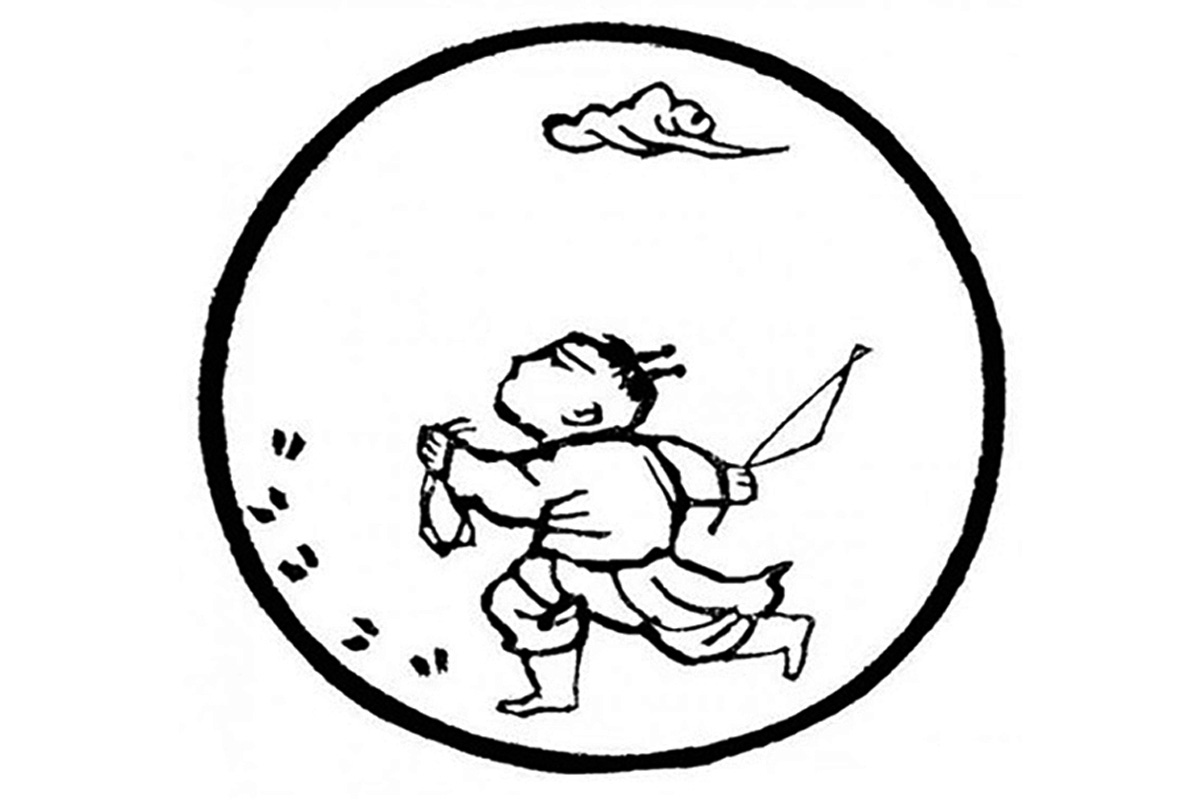
(Graphic: Plate 2 of the Ten Oxherder pictures of Zen)