
Jalal ad-Din Rumi
Intuitive Genius

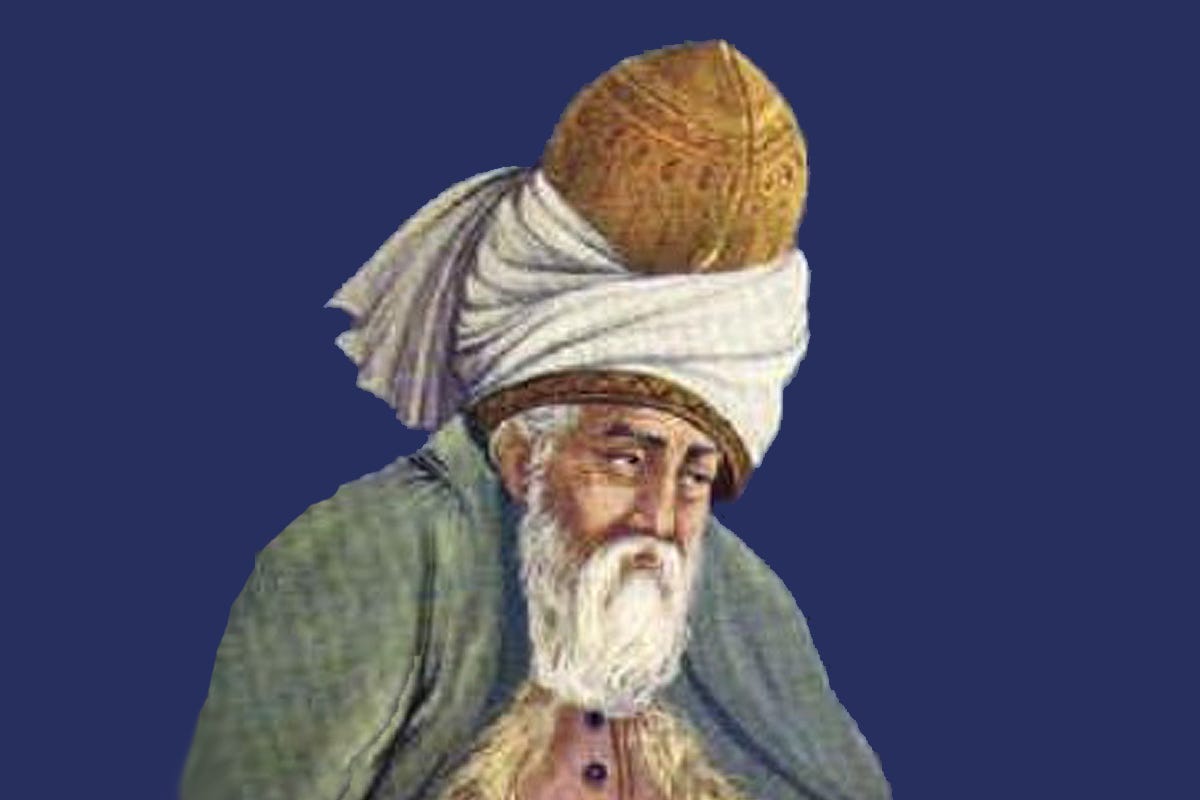
Come, come, whoever you are.
Wanderer, worshiper, lover of leaving.
It doesn’t matter.
Ours is not a caravan of despair.
Come, even if you have broken your vows a thousand times.
Come, yet again, come, come.
Jalal ad-Din Rumi was a Persian poet and a mystic who lived in the 13th Century. He was born in Balkh, Afghanistan, or in Vakhsh, Tajikistan - depending on report - and died in Konya, Turkey, aged 66. He is remembered both for his poetry and for the Mevlevi Order of Whirling Dervishes, which was founded by his followers after his death.
His father, Baha ud-Din Walad (born c. 1227), was the head of a ‘Madrassa’, or religious school, and when Baha died, Rumi took over his position. After that, he became a jurist and taught in the mosques in Konya. In 1244, he travelled to Damascus and met a Persian mystic, Shams-i Tabrizi (1185 – 1248). Rumi studied under Shams for four years until Shams died, under mysterious circumstances. The impact of Shams on Rumi was such that he credited all his later works to his influence.
All of this can be read in any account of Rumi and his life. What it doesn’t tell us is why he has remained an important influence more than 700 years since the time of his death. Rumi is regarded as one of the greatest poets of all time, both within and outside the Islamic world. In spite of the present friction between Islam and the West, he is the best-selling poet in America.
Western culture is governed by logic. Logic, by its very nature, is dry and intellectual, and our high regard for its precision and application is accompanied by the assumption that our emotions are merely a subjective addition to the intellect and as such they teach us nothing. Rumi’s poetry defies logic and speaks from the heart - and to the heart - and in a way which is both insightful and instructive.
Who makes these changes?
I shoot an arrow right,
It lands left.
I ride after a deer and find myself
chased by a hog.
I plot to get what I want
and end up in prison.
I dig pits to trap others
and fall in.
I should be suspicious
of what I want.
What makes Rumi’s poetry as relevant today as it was in the 13th Century is that it is informed by wisdom. The term ‘wisdom’ is too vague for conventional logic, simply because logic operates under the assumption that our present view of life is adequate to judge what is right and wrong. Wisdom is about seeing the bigger picture, about seeing beyond the obvious to what is presently excluded from our narrow-minded view of the world.
Out beyond ideas of wrongdoing and right doing,
There is a field.
I’ll meet you there.
Because Rumi lived within an Islamic culture, his poetry reflects that tradition and outlook, in the same way that Shakespeare’s poetry reflected the Elizabethan period that he operated in. But it would be wrong to say that Rumi’s poetry was constrained by Islam, not least because if it was, non-Muslims wouldn’t be able to relate to it. Nonetheless, when it does relate to Islam, it does so with the intention of throwing insight into its principles.
If the wine drinker
Has a deep gentleness in him,
He will show that,
When drunk.
But if he has hidden anger and arrogance,
Those appear.
And since most people do,
Wine is forbidden to everyone.
In addition to his poetry, Rumi is remembered for inspiring the Order of the Mevlevi Dervishes. Early Western accounts of the Mevlevi Dervishes describe them as dancing in a ‘frenzy of madness’. This view comes from a lack of understanding of the purpose of their particular form of dancing. The writer and thinker, P. D. Ouspensky (1878 - 1947), after travelling to Constantinople to witness the Dervishes himself, had the following to say about this ‘madness’:
‘Involuntarily I began to think that this is what is described as a mad whirling which drives them into a frenzy! If there is anything in the world which is the complete opposite of frenzy, it is precisely this whirling. There was a system in it which I could not understand, but which made itself clearly felt, and, what was most important, there was some intellectual concentration and mental effort, as though they were not only turning, but at the same time solving difficult problems in their minds.’
This was in 1908, before Ouspensky had come into contact with his own ‘Shams’, in the form of the mystic and teacher George Guirdjieff (c. 1866 – 1949). Gurdjieff’s teaching drew much from Sufism, including its dance tradition. After being instructed in the methods employed by the Dervishes, Ouspensky returned to Constantinople, in 1920, after Russia had been torn by revolution, and Europe had been decimated by war. He wrote that Constantinople too had changed:
‘I could not be certain after twelve years, but it seemed to me that I recognised several faces. And now I knew more about them. I knew a part of their secret. I knew how they did it. I knew in what the mental work connected with the whirling consisted. Not the details of course, because only a man who takes part in the ceremonies or exercises can know the details. But I knew the principle. All this did not make the miracle less. It only came nearer and became more significant. And at the same time I understood why they do not reveal their secret. It is easy to tell what they do and how they do it. But in order to understand it fully one must first know why they do it.’
What cannot be conveyed in words is the inner state invoked by the dancing. This must be experienced. The ceremony of Dervish dancing is called the ‘Sama’, which means ‘listening’. The listening it refers to is listening to the hidden silence behind all things. In order to hear it, we must be able to silence the chattering mind. Logic, rather than freeing us from the chattering mind, makes us slaves to it, and limits our experience of the world to what can be conveyed in words.
Why do you stay in prison
When the door is so wide open?
Move outside the tangle of fear-thinking.
Live in silence.
Perhaps that is why an academic approach to Rumi, based on formal reason and logic, misses the point and intention of his poetry. Rumi speaks of the hidden silence, not as a mere theory, but directly, as though he was speaking out of it.
This is how it always is
when I finish a poem.
A great silence overcomes me,
and I wonder why I ever thought
to use language.
The division between logic and intuition, which is the hallmark of Western culture, has resulted in a disconnection between the emotions and the intellect. The emotions, as they are ordinarily expressed, often emerge in a violent and uncontrolled fashion, in an outburst of anger or a flood of tears or a gasp of fear; this is our common understanding of the emotions. The emotion that imbues Rumi’s poetry is of an altogether different order. It is the emotion of ecstasy, and Rumi expresses it in both secular and religious language.
Last year, I admired wines.
This, I’m wandering inside the red world.
Last year, I gazed at the fire.
This year I’m a burnt kabob.
What warrants Rumi’s inclusion as an intuitive genius is the originality of his thought. Nothing of what Rumi expresses is second-hand. He does not rely on any authority for what he pronounces - he is that authority. The epithet given to him was ‘Mevlana’, which means ‘Master’. Rumi’s poetry is the very expression of ‘heart-thinking’, and of an intuitive mind of the highest order.