
Logic and Intuition
And why a new paradigm is emerging

We use logic to deal with what we know, and intuition to deal with what we don’t know. If we are satisfied that we already understand the world, we are probably more logical than intuitive.
Logic works by defining, labelling and categorising what we know. This is highly useful for putting our thinking into a coherent format and making it more precise. But we cannot apply logic to what we don’t know or cannot see clearly, and for this we need to employ intuitive thinking. There are many things we don’t know; we don’t know the future, we don’t know the past beyond what has been recorded in history, and we don’t know the hidden motives of others.
If we explain such things in terms of logic, for example if we project the present onto the past or future, or if we project our own assumptions about what motivates others to explain their behaviour, we will form an opinion about such matters, but one limited by our current thinking and understanding.
Intuition works very differently from logic. It begins with the gut-feeling that there is something more to what is presented than meets the eye. If we allow this feeling to work on us - and resist the temptation to explain the feeling logically - we may have an insightful thought into what the hidden element is.
Insight has played an important role in scientific thinking and invention, and yet it is little studied or understood. If logic is linear, insight is instant, emotional, and more like an image than a description. That is why it is sometimes depicted as a light bulb suddenly being switched on in a darkened room.
The physicist Frijof Capra had an experience of insight and described it in his book The Tao of Physics (1975):
‘I remember the first such experience. Coming, as it did, after years of detailed analytical thinking, it was so overwhelming that I burst into tears...’
The emotional element in his account is highly revealing. If logic is dry and analytical, an intuitive thought is personal, heart-felt, and highly insightful. In the highly intuitive culture of Gnosticism, for example, there is what was known as ‘Gnosis Kardias’, which means ‘knowledge of the heart’. If such things are presently regarded as unscientific, this has more to do with the dominance of logic in Western culture than with any genuine desire for knowledge.
We are taught to think logically at school, where, in a multiple choice exam, a question is followed by a series of possible answers. We work through the answers finding fault with each of them until, arriving at the answer without fault, we choose that one. If we do this successfully, we pass the exam. It is interesting to note that there are no equivalent exams in intuitive or creative thinking.
It is the dominance of logic in culture that has led to intuitive thinking being regarded as subjective, unorthodox, and not wholly reliable. It is also why intuitive culture where it has emerged - Gnosticism, Hermeticism, and Alchemy, for example - is similarly regarded, and why obvious geniuses such as Paracelsus are dismissed as oddballs and cranks rather than admired for the originality of their thought.
For all that, it is quite possible that there will be a shift in focus from logical to intuitive thinking in the coming years. The arrival of AI, or Artificial Intelligence, will render the capacity to think logically largely redundant. AI, even at its current stage of development, can reason far better than any human being, and it is likely it will continue to develop and quite possibly outstrip any human capacity in the coming years. Furthermore, it will render many forms of employment where logic and analysis are required, such as law, administration, and banking, largely redundant.
What AI cannot compete with in human thinking is in our ability to think imaginatively, creatively, and intuitively. For anyone who wants to remain in employment, it will be necessary to be able to do what AI cannot do - and indeed, do it effectively. To do this we will have to be able to move beyond the ‘right versus wrong’ mentality of logic, and consider, not what we already know, but what we don’t yet know. Those who are too enamoured with logic will find this very different form of thinking disconcerting.
It is not unreasonable to think there is more to the world than meets the eye, and this may be hidden, not just by physical means, but by the limitations of our own thinking. New thoughts, new ideas, and new insights are intuitive. If something doesn’t make sense, it may be because all that is required is a bit more logic, or because our intuitive mind is alerting us to consider what we presently can’t see or don’t know. The choice is ours.
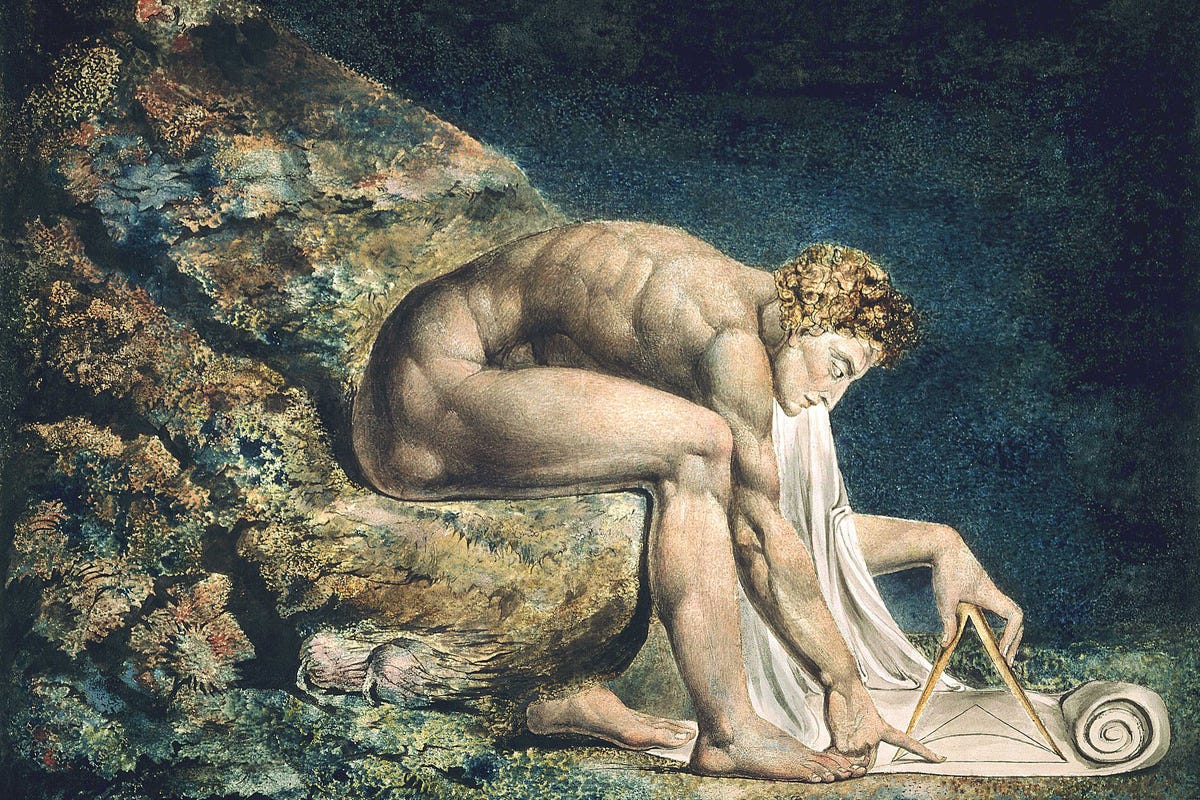
(Graphic: Isaac Newton by William Blake)